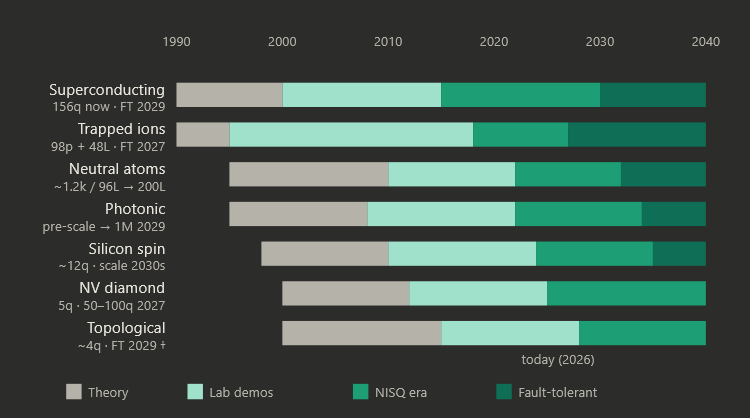
Qubit technologies roadmap — 2026 update with qubit counts
Each row shows current best demonstrated qubit count and the next major milestone the leading vendor is targeting. “p” = physical, “L” = logical, “FT” = fault-tolerant. Qubit technologies roadmap with 2026 qubit counts Updated timeline from 1990 to 2040 for seven qubit modalities, with each modality annotated with current physical and logical qubit counts and announced roadmap targets. 1990 2000 2010 2020 2030 2040 Superconducting 156q now · FT 2029 Trapped ions 98p + 48L · FT 2027 Neutral atoms ~1.2k / 96L → 200L Photonic pre-scale → 1M 2029 Silicon spin ~12q · scale 2030s NV diamond 5q · 50–100q 2027 Topological ~4q · FT 2029 † today (2026) Theory Lab demos NISQ era Fault-tolerant
Superconducting — IBM Heron R3 runs 156 physical qubits; Nighthawk (Nov 2025) has 120 qubits with denser coupling; Google Willow is 105q with below-threshold error correction. IBM’s roadmap: Starling 200 qubits + first useful fault tolerance by 2029, then Blue Jay 2,000 qubits by 2033. IBM Condor (1,121q) exists as a scaling demo.
Trapped ions — Quantinuum Helios (Nov 2025) is 98 physical + 48 logical qubits at 99.92% 2Q fidelity using a 2:1 color-code encoding ratio — the best logical-physical ratio in the industry. IonQ Tempo at 256 physical qubits. IonQ targets 20,000 physical / 1,600 logical by 2028, 2M physical / 80,000 logical by 2030, scaling through Oxford Ionics’ chip-integrated traps and Lightsynq’s photonic interconnects.
Neutral atoms — Atom Computing AC1000 holds 1,200+ qubits; QuEra (Jan 2026 Nature) demonstrated 96 logical qubits from 448 atoms using high-rate [[16,6,4]] codes, the current world record on verified logical qubits. Pasqal targets 10,000 atoms by 2026, 200 logical qubits by 2030. Microsoft + Atom Computing’s “Magne” machine (50 logical / 1,200 physical) ships to Denmark by early 2027.
Photonic — PsiQuantum stays secretive on intermediate qubit counts and bets the whole company on directly delivering a 1-million-qubit fault-tolerant machine by 2029 at deployment sites in Brisbane and Chicago. Xanadu’s Aurora is a 35-chip photonic system (13 km fiber-connected) targeting a fault-tolerant datacenter by early 2030s. Closed-form NISQ demonstrations are scarce — this modality skips the middle.
Silicon spin — Diraq demonstrated 4 industry-CMOS spin qubits at >99% fidelity on 300mm wafers (Nature 2025), Intel’s Tunnel Falls has 12 qubits at 99.9% gate fidelity. Roadmap is about scale rather than near-term qubit counts: Diraq targets billions of qubits per chip leveraging GlobalFoundries + IMEC 300mm CMOS lines, fault-tolerant horizon ~2030s. Quobly on STMicro 28nm FDSOI, Equal1 on GF 22FDX add commercial credibility.
NV diamond — Quantum Brilliance QB-QDK2.0 runs 5 qubits at room temperature and is deployed at Oak Ridge, Pawsey, Fraunhofer IAF. Roadmap: 25–100 qubit systems by 2026–2027, 50–60 logical qubits in lunchbox form factor by mid-2030s. The strategic edge is room-temperature embedded deployment (satellites, vehicles, edge), not raw qubit count.
Topological — Microsoft Majorana 2 (June 2026) is a 4-qubit array on a new InAs/Pb tetron material stack with 20-second parity lifetimes (1000× over Majorana 1). Microsoft revised its FT timeline from 2033 to 2029. † The fundamental question — whether these are genuinely topological qubits or measuring something else — remains contested in the condensed-matter community. Treat the 2029 target with appropriate skepticism.